Do Junk Removal Companies Recycle or Donate Your Items?
Discover how junk removal companies recycle or donate items and what sets eco-friendly services apart.
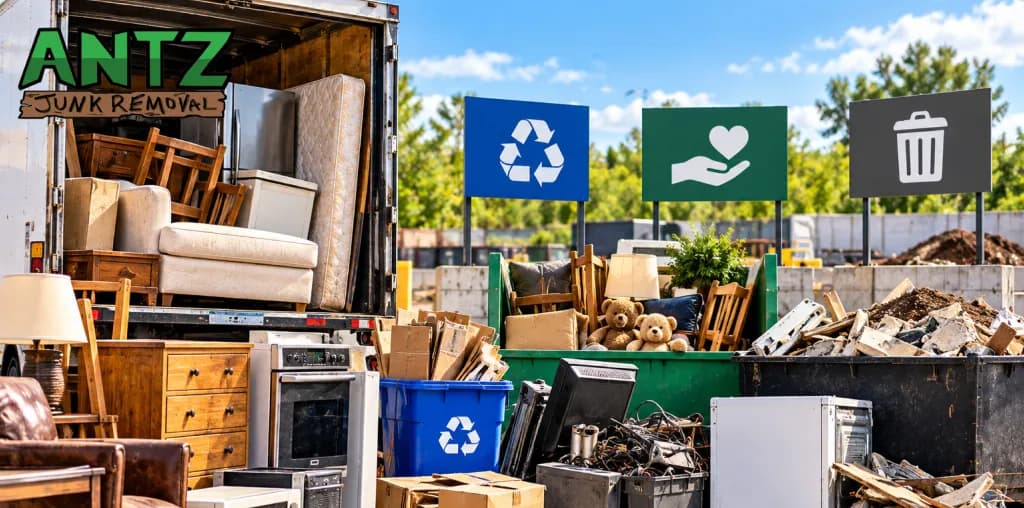
Most established haulers try to divert a meaningful share of what they collect away from the landfill through junk removal recycling and local donation partnerships but the actual percentage swings wildly depending on what's sitting in the truck. A load of soaked carpet padding and shattered drywall behaves nothing like a load of old bookshelves and a working microwave. One goes straight to a transfer station. The other has a second life ahead of it.
That distinction is the part most homeowners never think about until they're standing in the driveway watching a crew load up years of accumulated stuff. Some of it looks like garbage. Some of it isn't garbage at all it's just in the wrong house. A crew that knows the difference and sorts accordingly is doing something genuinely different from a company that treats every pickup as one undifferentiated dump run. This guide walks through how junk removal recycling actually work, what gets donated instead, and how to tell a company that means it from one that's just saying it.
What Happens to Junk After Pickup Leaves Your Driveway
Once a truck pulls away, the load doesn't go to one single destination it usually gets split three or four ways before the day is over. Other recyclable materials, such as metal, cardboard and appliances, are taken to a materials recovery facility or a scrap dealer. Good quality furniture and housewares are donated to a donation centre. All hazardous paint, propane tanks, some electronics are taken to a special disposal area since these items are not usually accepted with regular trash in the landfill. According to guidance published by the EPA's recycling program, materials like metal, cardboard, and electronics can often be recovered and reused rather than landfilled, provided they're separated correctly before disposal which is exactly the sorting step a careless hauler skips.
The remainder of the broken furniture with no resale value, waterlogged insulation, torn carpet, and construction debris heads to a landfill or waste-to-energy facility, because there's genuinely nothing else to do with it. Homeowners sometimes expect a 100% diversion rate, and no legitimate company can promise that. What separates a serious operation from a "load and dump" outfit is whether the recoverable portion of the load actually gets recovered. A grandfather clock with a cracked case might not be worth reselling, but the same load might include a solid oak dresser that a donation center like a Habitat for Humanity ReStore would take without hesitation, refinish, and resell to fund local home-building projects.
[Image: Junk removal crew sorting a mixed load of furniture, appliances, cardboard, scrap metal, and electronics into separate recycling, donation, and disposal categories at a clean facility]
How Junk Removal Companies Dispose of Items They Can't Reuse
Not everything qualifies for junk removal recycling or donation, and a crew that pretends otherwise is either inexperienced or not being straight with you. Items with structural damage, mold contamination, or missing hardware usually fail donation intake standards. Most nonprofits won't accept furniture that's stained, broken, or infested, because they can't resell it and don't have the staff to repair it.
For the non-recoverable portion the part junk removal recycling can't do anything with disposal generally runs through a licensed transfer station or municipal solid waste facility. This is where regional permitting and landfill capacity actually matter. In areas with limited landfill space, haulers pay tipping fees calculated by weight, which is part of why a responsible company sorts before dumping rather than after every pound diverted to recycling is a pound that doesn't cost a tipping fee and doesn't take up landfill volume. That's a business incentive as much as an environmental one, and it's worth knowing, because it means the greenest haulers usually aren't acting purely out of goodwill. They're also managing overhead.
Junk Removal Recycling: What Actually Gets a Second Life
Junk removal recycling cover a narrower category than people assume. It's not "anything that could technically be recycled" it's the materials that local recycling facilities are actually designed for. The most reliable is scrap metal appliances, pipe, wiring, and structural steel they're all pretty easy to pull and sell to a scrap metal dealer, as there's a pretty consistent market for reclaimed metal.
Electronics are trickier. A working laptop or television might get refurbished and resold, but a cracked monitor or a dead hard drive typically goes through junk removal recycling channels meant for e-waste. Specifically, these facilities strip out circuit boards, batteries, and heavy metals so they don't end up leaching into groundwater from a standard landfill cell. Wood furniture that's too damaged to donate can sometimes be broken down and recycled as mulch or biomass, though that depends entirely on whether a facility offering that service exists within a reasonable hauling distance.
What Items Can Be Recycled After Junk Removal
Homeowners asking what items can be recycled after junk removal are usually surprised by how specific the answer is. The realistic list includes:
Metal appliances (washers, dryers, water heaters, most kitchen appliances)
Scrap metal, piping, and wiring
Clean cardboard, paper, and some plastics
Electronics through certified e-waste junk removal recycling partners
Mattress components (steel springs are pulled and recycled; foam is harder to place)
Concrete and masonry debris, which some facilities crush and reuse as fill material
Glass and certain plastics are the weak spot. Unless a hauler has a specific outlet for them, they often end up in general waste not because a company is being lazy, but because the regional recycling market for those materials genuinely doesn't exist everywhere.
Do Junk Removal Companies Recycle Items Like Metal and Electronics?
Yes, and this is where the gap between companies is widest. Metal recycling is close to universal among established haulers because scrap dealers pay for it there's a financial reason to sort it out, not just an ethical one. Electronics are a different story. Proper e-waste handling requires either an in-house partnership with a certified recycler or a scheduled drop-off, and it takes extra time that a crew focused purely on speed has no incentive to spend.
This is the clearest test of real junk removal recycling commitment versus a marketing claim. A quick way to tell the difference during a phone estimate: ask what specifically happens to a dead refrigerator or a broken TV after pickup. A company doing real junk removal recycling work will name an actual facility or process Freon recovery for appliances, certified e-waste breakdown for electronics. A company that says "we take care of it" without specifics usually means it goes in the same truck as everything else.
Do Junk Removal Companies Donate Furniture and Working Appliances?
Reputable companies do, but donations have stricter intake standards than most homeowners expect. Nonprofits that have limited staffing resources and limited budgets for repairs typically don't accept items at their donation center door that require repair projects, such as a couch with a rip, a dresser that has a missing drawer or an appliance that hasn't been tested. Furniture must be structurally strong, reasonably clean and full to be considered.
That's actually good news for anyone downsizing. If a piece is still functional, it's worth setting aside and mentioning to the crew before pickup rather than assuming it's headed for the dump by default. A five-minute conversation can be the difference between a dresser landing in a landfill and it furnishing someone's first apartment.
What Items Can Be Donated Instead of Thrown Away
The items with the best donation odds tend to be:
Furniture without structural damage, tears, or stains
Working small and large appliances (tested before pickup, ideally)
Mattresses in donatable condition note that some nonprofits refuse mattresses entirely due to bedbug liability, so this varies by organization
Tools, building materials, and hardware, which building-materials reuse stores actively seek out
Housewares, décor, and unused building supplies left over from renovation projects
Anyone specifically wondering what items can be donated instead of thrown away should know that donation centers evaluate condition first and category second a functional item beats a "nicer" item that's broken every time.
The Eco-Friendly Junk Removal Process, Step by Step
A genuinely eco-friendly junk removal process looks different from a standard haul, mostly in how much sorting happens before anything leaves the property.
Walk-through and assessment
An experienced estimator's reputation is built when the crew evaluates what is recyclable, can be donated to or is landfill only when quoting the job.
Pre-sort at pickup
Recyclable and donatable items are separated from the remainder of the waste stream within days of the collection – not behind the scenes in a warehouse.
Load segregation
Trucks or trailers are loaded with recoverable materials kept apart from waste-bound items whenever the vehicle setup allows it.
Routing to the correct facility
Metal goes to a scrap dealer, electronics to a certified e-waste processor, furniture and housewares to a donation partner.
Documentation
Better companies can tell you, at least generally, where categories of items ended up even if they can't track an individual chair to its final resting place.
Landfill as the last resort, not the default
Only the genuinely non-recoverable portion damaged, contaminated, or unmarketable material goes to a transfer station.
[Image: Organized junk removal process showing workers separating recyclable materials, donatable furniture, electronics, and non-recoverable waste before transporting each category to its appropriate facility]
Mistakes Homeowners Make When Trying to "Go Green" With Junk Removal
The most common mistake is assuming that hiring any hauler automatically means an eco-friendly outcome. Sorting takes labor, and labor costs money. A company with rock-bottom pricing and no stated process for junk removal recycling is almost certainly skipping the sort step, because that's the fastest place to cut costs.
The second mistake is over-trusting the condition. Homeowners frequently assume a stained mattress or a water-damaged dresser is "still good enough to donate." It isn't, by most nonprofit standards, and a hauler who tells you that upfront isn't being unhelpful they're being accurate. The third mistake is waiting until pickup day to mention which items matter. By the time a crew arrives, they're working against a schedule, and specific requests get lost if they aren't flagged during the initial estimate.
Full-Service Junk Removal vs. Sorting It Yourself
Full-service junk removal is where you point, the company loads, they haul and the cleanup is done. Self-sorting requires you to drop off each item at a scrap yard, a donation center and a transfer station, it is more labor intensive but allows you to have more control over what you drop at each location.
A few factors that actually decide which makes sense:
Volume of items
A handful of pieces is manageable solo. A whole-house cleanout usually isn't, purely on time and vehicle capacity.
Item condition variety
Mixed loads (some donatable, some recyclable, some trash) benefit from a crew that already has relationships with multiple facilities.
Physical demands
Heavy appliances and furniture involve real injury risk without the right equipment or a second set of hands.
Time constraints
Coordinating separate drop-offs at three different facilities can eat an entire weekend that a single scheduled pickup handles in a couple of hours.
Certainty about outcomes
If knowing exactly where an item lands matters to you, self-sorting gives more direct control than handing off a mixed load.
Questions About Junk Removal Services and Where Items End Up
People calling around for junk removal services tend to ask a similar handful of questions once they start thinking past "just get it out of my house." For instance, one that comes up constantly is whether a company can guarantee a specific item gets donated rather than landfilled and the honest answer is usually "we'll try, but donation centers have final say on intake."
Do all junk removal companies recycle or donate items?
Others are simply haul-and-dump facilities, especially low-cost facilities that do not have partnerships with recycling and/or donation operations. The only way to be sure is to ask directly in the estimate.
What happens to junk after pickup if nothing is salvageable?
It is collected from the home on the same day or within a few days of collection, depending on the hauler's schedule.
Can I request that specific items be donated rather than recycled or trashed?
Yes, most crews will follow specific orders if the request is made clearly before or on pickup, but it's much more difficult to differentiate later when everything is loaded together.
Are there items junk removal companies refuse to take at all?
Some hazardous materials items such as paint, chemicals and certain types of electronics may not be collected with regular garbage and will depend on local ordinances for hazardous-waste drop off.
Does eco-friendly junk removal cost more than standard hauling?
Not necessarily. Sorting can reduce landfill tipping fees, which sometimes offsets the added labor. Pricing varies by company and by what's actually in the load.
What Separates a Genuinely Eco-Friendly Hauler From a Greenwashed One
There's a lot of jargon that's used in this field and the term “eco-friendly” is not something that should be taken at face value be wary of any company that puts the label on without explaining what they actually do during the course of the junk removal recycling process.
A company that actually practices junk removal and recycling can describe its process in specifics which facilities it uses, how it separates loads, what happens to electronics versus furniture versus scrap metal. A company that just prints a green logo on the truck and calls it a day usually can't answer those questions with any detail. The difference isn't marketing language. It's whether sorting happens at all, and whether the crew treats a donatable dresser differently than a broken one.
Get Eco-Friendly Junk Removal Done Right With Antz Junk Removal
Antz Junk Removal offers the option of junk removal recycling which is designed to sort recyclable materials, donatable furniture and anything truly trash into individual categories and send them to the appropriate place instead of them all going in one truck. Contact Antz Junk Removal at 719-922-0428 to discuss what's in your load and how it will be handled a quick conversation about item condition upfront usually results in more of it getting recycled or donated instead of landfilled.